


The Causes of Low Production Efficiency
Low production efficiency is a major challenge across many industries, resulting in high costs, delayed deliveries, inconsistent quality, and a loss of competitiveness.
You May Also Like


These problems rarely stem from a single factor. Instead, they result from multiple interconnected elements, including processes, personnel, machinery, factory layouts, and management data.
In this article, Solwer explores the root causes behind low production efficiency and provides timely, actionable solutions to resolve them.
Core Causes of Low Production Efficiency
Production efficiency is the heartbeat of competitiveness in today’s industrial landscape. Factories capable of producing goods rapidly, with high quality and low costs, gain a clear competitive edge in meeting customer demands and driving profitability.
However, many factories still struggle with low production efficiency, resulting in high costs, delayed deliveries, and inconsistent product quality. These problems do not stem from a single factor. Instead, they are the result of multiple interconnected elements. These include hidden waste within production processes, loose management, neglected machinery, skill gaps among personnel, and incomplete data flow.
When these deficiencies accumulate, they become major barriers to boosting productivity, preventing organizations from fully utilizing their resources. Understanding the root causes of these inefficiencies is the essential first step in planning process improvements and elevating a factory’s long-term competitiveness.
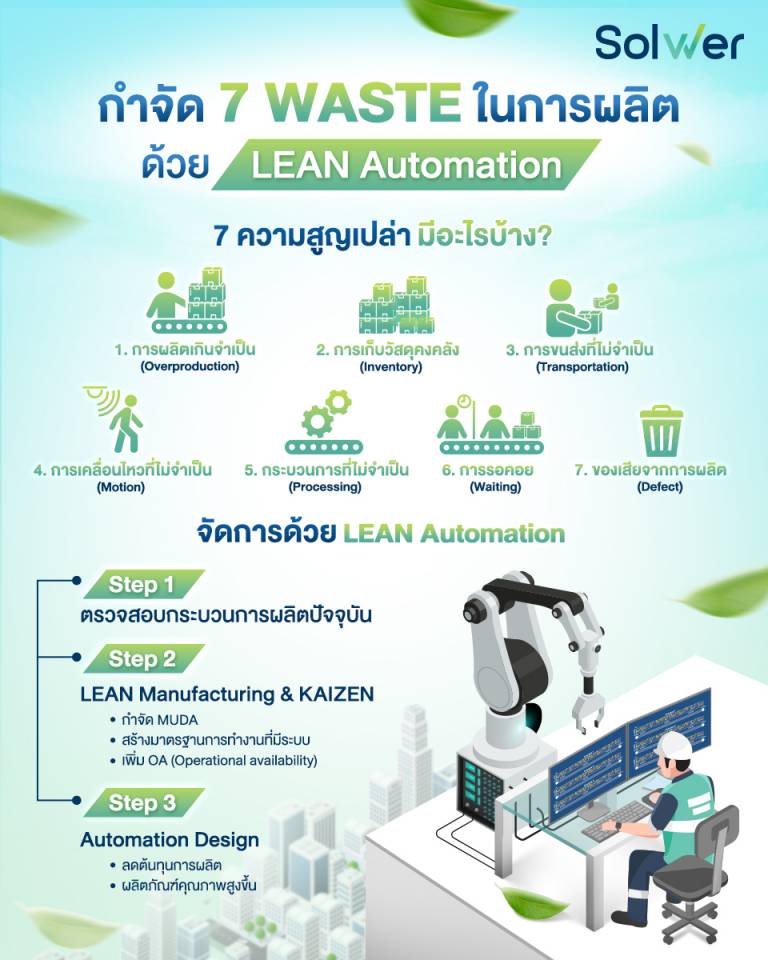
1. Production Process Waste (The 7 Lean Wastes)
The core of Lean principles is the relentless elimination of non-value-added activities within the production flow. These 7 Wastes are the primary culprits behind inflated costs, degraded efficiency, and compromised competitiveness. Deeply understanding each type of waste empowers factories to expose hidden bottlenecks and implement highly effective, targeted improvements.
1.1 Overproduction
Overproduction is the most severe waste in Lean because it inevitably triggers other types of waste. Producing more than actual demand—whether due to forecasting errors, a desire to keep machines running, or trying to hit efficiency targets—results in excess inventory. Capital becomes tied up in goods that may not sell in time, increasing the risk of product degradation or obsolescence. It also inflates storage, handling, and inspection costs, none of which add value for the customer.
1.2 Waiting
Waiting occurs when production flow is interrupted, leaving employees, machines, or work-in-progress idle. Causes include delayed materials, machine breakdowns, pending instructions, or waiting for quality inspections. These delays extend lead times, increase costs, and cause late deliveries. While often invisible without detailed tracking, waiting severely impacts factory agility. Even when employees are at their stations, actual non-productive time is often higher than expected.
1.3 Transportation
Moving raw materials or work-in-progress over excessive distances adds zero value to the product. Often caused by poor factory layouts—such as placing materials far from workstations, separating consecutive processes, or lacking optimized routing—excessive transportation wastes time and labor. It also increases the risk of product damage and workplace accidents. Minimizing unnecessary movement is a crucial step in achieving a smoother production flow
1.4 Motion
Unlike transportation, which involves moving goods, Motion refers to the unnecessary physical movements of employees or tools. Actions like walking to fetch distant tools, frequent bending, reaching for poorly placed items, or excessive turning may seem minor. However, when repeated throughout the day across the production line, they result in significant time loss, worker fatigue, and an increased risk of injury. Optimizing workstations using Ergonomics and 5S principles effectively eliminates this waste.
1.5 Overprocessing
Overprocessing means performing more work or using more complex steps than necessary—essentially, doing more than the customer requires. Examples include redundant inspections, using high-end machinery for simple tasks, or engineering products beyond the required quality standards. This drives up costs, consumes time, and overcomplicates production. Often mistaken for “fine work” or “high quality,” it simply adds expense without adding value. Doing exactly what is needed is the core of Lean. Want to know more about Lean? Download the Solwer E-Book now!

into Productivity
industrial experts.
1.6 Inventory
Holding excess raw materials, work-in-progress (WIP), or finished goods is a silent waste. Inventory ties up significant capital in assets that do not generate immediate revenue. It also incurs additional costs for storage, inspection, and stocktaking, while increasing the risk of product degradation or loss. Often driven by the fear of shortages, large batch production, excessive safety stock, or poor inter-departmental coordination, reducing inventory to optimal levels enhances operational agility, lowers costs, and improves customer response times.
1.7 Defects
Producing goods that require rework, repair, or scrapping is one of the most costly wastes. Defects waste raw materials, labor, machine time, and inspection resources, often forcing the production line to halt. They also damage factory credibility and customer satisfaction. Root causes include machine inaccuracies, poor-quality materials, unclear procedures, or inadequate training. Implementing mistake-proofing systems (Poka-Yoke) and preventive quality control is essential for sustainably reducing this waste.

2. Management & Process Issues
Management and process flaws are primary reasons factories fail to sustain high efficiency. Even with state-of-the-art machinery and technology, a lack of clear systems, standardized work, or optimized layouts inevitably fills the production line with waste and variation. Deeply understanding these root causes is crucial for implementing effective, systemic improvements.
2.1 Non-Standardized Processes
A common factory pitfall is the absence of clear Standard Operating Procedures (SOPs) or relying on outdated ones that do not reflect actual floor conditions. Without standardization, employees rely on their own familiar methods, leading to inconsistent work practices. This introduces immense variation in both time and quality, destroying production stability. The fallout includes erratic product quality, higher defect rates, and fluctuating production times that create planning nightmares and process Bottlenecks. These issues can be identified through direct observation, measuring Cycle Time Variation, or conducting audits.
Fixing this requires establishing a robust Standard Work system that defines the exact sequence, Cycle Time, and production pace aligned with customer demand (Takt Time). Coupling this with Visual Work Instructions empowers employees to understand processes instantly. Additionally, creating a centralized knowledge base—like a work standard book—and enforcing reviews after every process change ensures standards remain relevant and are consistently applied.
2.2 Poor Factory Layout
A poorly optimized factory layout generates unnecessary waste. When equipment, machinery, or workstations are placed too far apart or misaligned with the production sequence, it causes excessive transportation and motion. This wastes time, increases employee physical strain, and disrupts the seamless flow of work. This issue is typically diagnosed using tools like a Spaghetti Diagram to trace movement paths, alongside Time & Motion Studies to precisely quantify time loss.
The solution starts with redesigning the layout to align with the actual workflow—such as implementing a U-shape or Cellular Layout to ensure continuous processing and maximize space utilization. Utilizing Point-of-Use Storage drastically cuts travel distance and eliminates unnecessary motion. Before full implementation, running a pilot layout allows teams to test efficiency and fine-tune operations before scaling factory-wide.
2.3 Ineffective Production Planning and Sequencing
Inefficient production planning usually stems from frequent order changes, a lack of Sales & Operations Planning (S&OP), or making decisions without real-world data. These flaws create extreme volatility on the production line: some processes stall while waiting, while others are pushed to the breaking point. This imbalance inevitably leads to Overproduction in certain SKUs and Stockouts in others, forcing unnecessary overtime and inflating overall costs.
Correcting this requires establishing a rigorous S&OP and Master Production Schedule (MPS) to balance customer demand with actual manufacturing capacity. Leveraging Finite Scheduling tools helps simulate workloads and sequence jobs realistically. Furthermore, stabilizing production using the Heijunka (production leveling) concept and pacing output to Takt Time ensures a steady workload, minimizes fluctuations, and builds a highly stable production line.
2.4 Redundant Inspection
Over-inspecting or redundant quality checks are rampant in factories that rely solely on end-of-line inspections, entirely missing the point of origin. Redundant inspections inflate labor costs, consume valuable time, and extend Lead Time without ever fixing the root cause. Crucially, more inspections do not equal better quality. If the source of the defect is not eliminated, the problem will relentlessly repeat itself.
The proper fix is to eliminate non-value-added inspections and shift focus to source-level quality control. Implementing Poka-Yoke (mistake-proofing) mechanisms prevents errors at the very beginning of the process. Adding In-Process Controls at high-risk stages, and moving inspection points from the end of the line directly to where the issues actually occur, allows for instant correction. This drastically reduces defects and significantly boosts overall production efficiency.
3. Workforce and Machinery Challenges
Issues stemming from personnel and equipment are major drivers of plummeting production efficiency. Because both People and Machinery are the core engines of your factory, they must operate in seamless synergy. When your workforce lacks readiness or your machinery loses stability, the entire production flow inevitably breaks down. This section explores four critical challenges in these areas and provides systematic, actionable solutions to overcome them.
3.1 Inadequate Training
A lack of effective training severely cripples production efficiency. This is especially prevalent during rapid scale-ups or mass hiring phases when factories lack a structured knowledge transfer system. New hires are forced to learn by trial and error or rely on informal peer guidance. This drastically extends the time needed to reach standard performance levels and spikes the risk of errors due to inconsistent work methods.
Without standardized skills, quality variation is inevitable. Minor individual differences in execution compound into major defects on the production line. Furthermore, the slow ramp-up time of new operators drags down total line productivity and overburdens experienced staff who must constantly supervise and correct mistakes.
The solution begins with implementing a comprehensive Training Matrix. This maps out required skills, target proficiency levels for every role, and systemic re-evaluation cycles, allowing management to visualize workforce capabilities and target development precisely.
Next, establish structured On-the-Job Training (OJT). This must be supported by standardized manuals—such as visual aids, videos, or step-by-step guides—ensuring both trainers and trainees follow the exact same protocol. This eliminates deviations and guarantees consistent knowledge transfer.
Finally, before deploying staff to the live floor, they must pass a rigorous Certification process or a Skill Checklist evaluation to confirm they can operate correctly, safely, and to standard. A robust, formalized training system is the ultimate key to reducing errors, elevating quality, and embedding long-term stability into your production process.
3.2 Employee Fatigue and Stress
Fatigue and stress are the silent destroyers of quality and safety on the production floor. When operators endure prolonged, repetitive tasks in suboptimal environments, their decision-making capabilities and overall efficiency plummet. Red flags such as rising Absenteeism, spiking Defect Rates, and an increase in workplace accidents are the direct fallout of a physically and mentally exhausted workforce.
Combating this requires a comprehensive approach that addresses both physical and mental well-being. Solutions include redesigning workstations based on strict Ergonomics to eliminate cumulative physical strain, implementing Job Rotation to prevent monotonous overexertion, and optimizing shift schedules to align with human limits. Furthermore, establishing structured rest intervals, proactive health monitoring, and consistent workload tracking will sustainably elevate the work environment and protect your most valuable asset—your people.
3.3 Equipment Breakdowns
Unstable machinery is a primary trigger for sudden Unplanned Downtime and inflated Mean Time to Repair (MTTR). This not only slashes production volume but also forces operators into idle waiting and frequently compromises product quality. This crisis is typical in factories stuck in a reactive “fix-it-when-it-breaks” mindset, entirely lacking a proactive maintenance culture.
The most effective countermeasure is implementing Total Productive Maintenance (TPM), specifically its core pillar: Autonomous Maintenance. Empowering machine operators to take ownership of basic daily inspections and upkeep drastically reduces failure rates. Factories must establish rigorous Preventive Maintenance Schedules detailing exact inspection cycles, parts replacement, and systematic data collection.
Furthermore, continuously tracking key metrics like MTBF (Mean Time Between Failures) and MTTR is essential for predictive trend analysis. Finally, enforcing mandatory daily pre- and post-shift Checklists ensures minor anomalies are caught and resolved long before they escalate into catastrophic machine failures.
3.4 Inconsistent Material Supply
A disrupted material flow is a primary catalyst for sudden production bottlenecks. These interruptions typically stem from fragile supply chains—unreliable supplier deliveries, prolonged transit times, or erratic raw material quality. Material shortages force immediate line stoppages and frantic schedule changes, simultaneously crippling overall efficiency and inflating operational costs.
The strategic solution begins with proactive Supplier Development to collaboratively elevate delivery punctuality and baseline quality with your partners. Securing long-term agreements further stabilizes your supply pipeline. Where applicable, integrating Just-In-Time (JIT) or Vendor-Managed Inventory (VMI) systems effectively shifts the burden of stock management directly to the supplier. Additionally, a mathematically rigorous Safety Stock calculation acts as a critical buffer against delivery uncertainties, guaranteeing an uninterrupted and seamless production flow.
4. Technology and Data Challenges
4.1 Utilizing Inadequate Tools and Equipment
Deploying inadequate tools and equipment is a primary driver of production defects, particularly in operations demanding high accuracy, such as precision assembly or rigorous quality control. Continuing to rely on machinery that lacks the required Precision guarantees that the output will deviate from acceptable tolerances. This destroys product quality, shatters process stability, and inevitably triggers massive spikes in rework and scrap rates.
The root cause is often a failure to systematically evaluate equipment capabilities prior to deployment. Many facilities force legacy equipment to handle next-generation products that demand much tighter tolerances, silently eroding overall efficiency.
The solution starts with conducting a rigorous Machine Capability Study (Cpk/Ppk) to verify whether the equipment can actually operate within required specifications. Following this, a comprehensive Cost-Benefit Analysis (ROI) must be performed to weigh the financial justification of upgrading or replacing the machinery. If data proves that your current tools are the bottleneck to quality, strategic technological upgrades are absolutely non-negotiable for sustaining long-term operational excellence.
4.2 Fragmented Data Integration
Disconnected data systems are a critical catalyst for production discrepancies. Far too many factories still operate in departmental silos, where purchasing, warehousing, production, and planning rely on fragmented information. When your ERP or MES data misaligns with the reality on the floor—such as physical inventory mismatches or delayed sales updates driving incorrect job sequencing—chaos ensues. These blind spots inevitably trigger Stockouts, Overproduction, and severe scheduling errors that directly sabotage your efficiency and inflate operational costs.
To eradicate these silos, organizations must enforce rigorous Data Governance. This requires defining clear Data Owners, establishing a Single Source of Truth, and synchronizing data updates across all departments. The ultimate goal is seamless system integration—linking MES or SCADA directly to your ERP for real-time visibility, completely eliminating manual data-entry risks.
For facilities not yet ready for massive IT overhauls, starting agile is highly effective. Deploying lightweight digital tools like Digital Kanban or real-time Dashboards for daily production and inventory tracking provides an immediate leap in data accuracy, building a solid foundation before scaling to full automation.
Summary: Root Causes of Low Efficiency and Strategic Roadmaps for Systemic Improvement
Low production efficiency is rarely the result of a single isolated failure. Instead, it is the cumulative fallout of multiple interconnected factors—ranging from Lean Wastes and non-standardized management to gaps in workforce readiness, machinery stability, and technological integration.
When a factory is riddled with non-value-added activities—such as excessive waiting, unnecessary motion, defects, or bloated inventory—productivity naturally plummets. Simultaneously, management flaws like non-standardized workflows, poor layouts, ineffective sequencing, or redundant inspections force valuable time and resources to be squandered.
Furthermore, human factors—including inadequate training, fatigue, and stress—combined with unpredictable machine breakdowns, directly sabotage quality and production continuity. These issues are further compounded by fragmented data and mismatched technology, such as low-precision tools or disconnected ERP/MES systems, which trigger planning errors and flawed decision-making.
When these challenges overlap, organizations face skyrocketing costs, mounting waste, inconsistent quality, and the inability to meet delivery schedules efficiently. Conducting a root-cause analysis and implementing a systematic improvement plan is, therefore, paramount.
For those looking to dive deeper into analyzing and resolving these issues step-by-step—whether through Lean waste reduction, establishing standardized work, redesigning factory layouts, setting up preventive maintenance, or enhancing workforce capabilities—explore more in the Solwer E-Book.
Our E-Book compiles proven concepts, techniques, and practical tools designed for real-world application, helping you visualize the big picture and providing a roadmap to sustainable productivity growth. You can also explore more articles on enhancing production line efficiency on the Solwer website.
into Productivity
industrial experts.