


3 Common Factory Problems That “Loss Tracker” Visualizes Instantly
In modern manufacturing, where competitiveness is defined by efficiency and speed, many factories struggle to identify and eliminate “Losses” within their production lines. These are often small, subtle issues that are difficult to detect manually but have a massive cumulative impact on overall performance.
You May Also Like

To address this challenge, Loss Tracker was developed as an intelligent production loss analysis tool. It is specifically designed to transform invisible problems into concrete, actionable data for improvement. Today, Solwer will introduce you to three common factory problems that occur regularly—and show you how Loss Tracker acts as the perfect solution to solve them!
What is Loss Tracker?
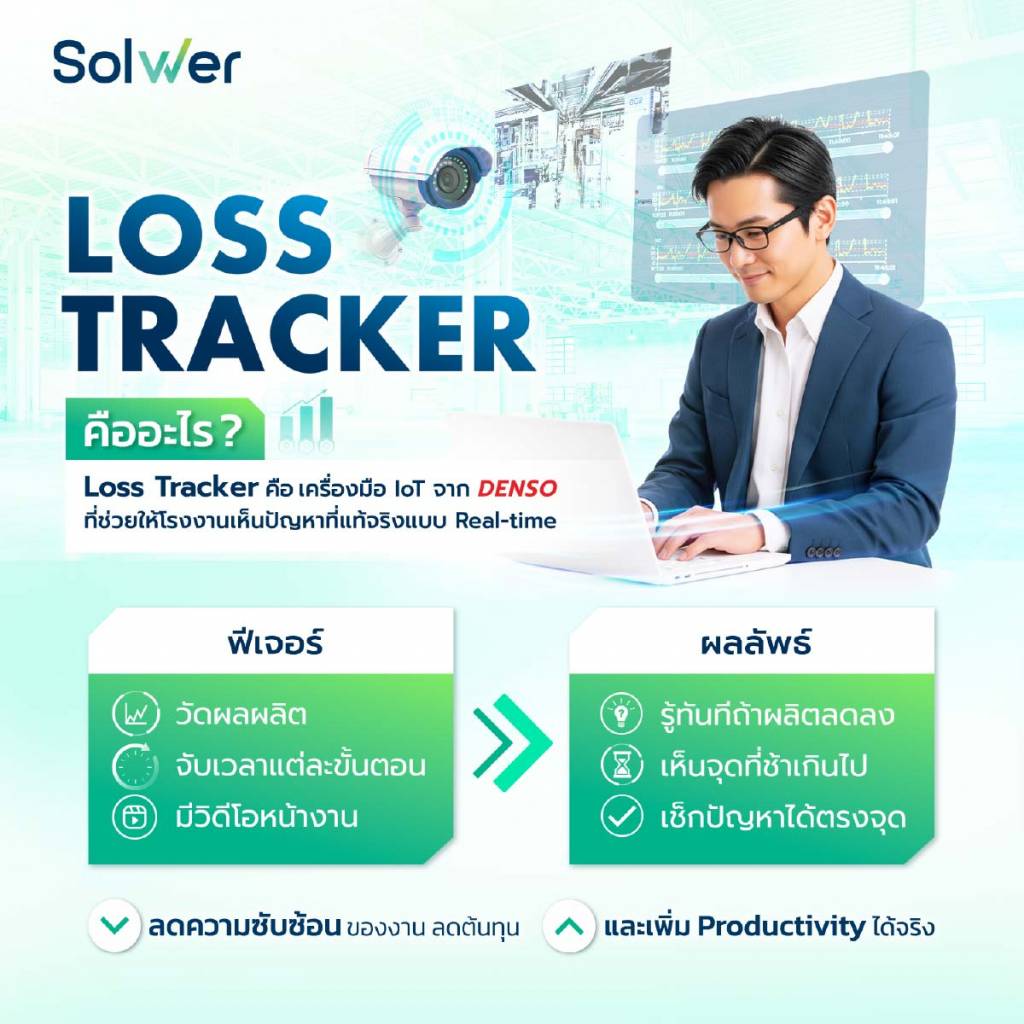
Loss Tracker by DENSO is a Lean Automation solution specifically designed to systematically link “real-world floor data” with “improvement activities” (Kaizen). The standout feature of this system is its ability to make production Losses clearly visible, enabling rapid and precise corrective actions.
At its core, Loss Tracker leverages Internet of Things (IoT) technology to connect directly with machinery or production processes. It automatically collects operational data in real-time, replacing traditional manual data logging and stopwatch timing—methods often prone to human error and delays. By providing accurate and continuous data, Loss Tracker ensures total transparency within the production line through 3 Key Visualization Functions that bridge the gap between data and improvement.
To gain a deeper understanding of how Loss Tracker can transform your operations, download our E-book now!

into Productivity
industrial experts.
The 3 Core Visualization Functions)
1. Output Progress (Plan vs. Actual)
This function displays production output compared to the target plan in real-time, tracked hour by hour. When a GAP (variance) occurs, floor staff are alerted immediately, allowing them to assess the situation and resolve issues before they escalate.
2. Cycle Time Analysis
The system automatically captures operational data for every individual process. By monitoring these metrics, it can precisely detect “Abnormal Cycle Times,” pinpointing exactly which step in the production line is acting as a Bottleneck.
3. VDO for Root Cause
Loss Tracker features 24-hour continuous video recording of the workspace. When an abnormality is detected, the system automatically syncs and clips the specific footage related to that irregular Cycle Time. This allows engineers to instantly review the event and conduct a high-speed Root Cause Analysis of the production loss.
3 Common Factory Problems: How Does Loss Tracker Solve Them?
1. The Inability to Locate "Hidden Losses"
The Challenge in Detail: Every day, small “leaks” in efficiency occur that are invisible to the naked eye or manual logs. These aren’t major machine breakdowns but rather repetitive “stumbles” throughout the day, such as:
Minor Stoppages: Machines pausing for 1–2 minutes while waiting for materials or operators. These are rarely recorded manually.
Speed Loss: Machines running slightly slower than the standard set speed, which often goes unnoticed without precise tracking.
Waiting: Operators in one step idling while waiting for workpieces from a previous stage.
When these happen once, they seem trivial. When they happen repeatedly every day, they accumulate into massive amounts of wasted labor hours, directly impacting costs and total production capacity.
How Loss Tracker Helps: Loss Tracker acts as an intelligent “sensor” connected directly to your production line. It automatically records every event, whether it’s a 5-second pause or a minor drop in speed. The system converts this data into easy-to-read graphs and reports, allowing managers to instantly see where, when, and how often these hidden losses occur. This enables you to target the small problems that were previously overlooked.
2. Kaizen Processes That Take Too Long and Rely on Guesswork
The Challenge in Detail: Kaizen is the heart of factory development, but improvement requires knowing the problem first. Traditionally, this is exhausting. Teams might spend days standing with a stopwatch to measure Cycle Times, or rely on manual operator logs which are often inaccurate. Consequently, analysis and solutions are based on “gut feeling” or “experience,” which isn’t always correct.
How Loss Tracker Helps: Loss Tracker revolutionizes the Kaizen process by displaying real-time data on a digital dashboard. There is no longer a need to wait for manual data collection. Teams can instantly see:
The Actual Cycle Time for every step and how it compares to the target.
Hourly Output versus the production plan.
With factual data in hand, teams can identify bottlenecks and plan improvements immediately. This significantly shortens the improvement cycle, ensuring every decision is data-driven, not based on guesswork.
3. Lack of Clear Data for Evaluating Production Efficiency
The Challenge in Detail: For executives, a high-level view of Productivity is vital for strategic planning. However, reports are often just daily summaries that don’t explain “Why” output was low. This leads to inaccurate manpower planning, misinformed machinery investments, or unrealistic production targets because the true bottleneck remains unknown.
How Loss Tracker Helps: Implementing an IoT-driven Loss Tracker is a game-changer for reducing waste. It provides production leads and management with real-time production insights. The continuous data recording supports Lean and Kaizen principles by pinpointing waste.
The system allows teams to analyze the Root Cause through deep-dive data, such as synchronized video or specific Cycle Time (CT) trends. This systemic summary allows executives to see the big picture of total efficiency and categorize losses accurately to make better business decisions for profit and cost reduction:
Machine Loss: Issues originating from equipment performance.
Man Loss: Issues originating from human workflows or processes.
Material Loss: Issues originating from raw material quality.
The Strengths of DENSO Loss Tracker: Driving Advanced Production Efficiency
To make Lean Automation and Kaizen concepts a reality, factories need tools that can measure, analyze, and drive actual improvements on the shop floor. DENSO Loss Tracker is purpose-built for this mission. Its strength lies not only in accurately identifying and managing “Losses” but also in serving as a key mechanism to elevate factory competitiveness and lay a sustainable foundation for growth in the digital industrial era.
Kaizen Track-back: Data-Driven Kaizen
The heart of DENSO Loss Tracker is its support for a clear, measurable, and continuous “Improvement Cycle” known as Kaizen Track-back. This cycle consists of 4 vital steps:
1. Analyze Loss
The first step of using Loss Tracker is making “Hidden Losses” visible. The system captures and displays critical data, such as machine Downtime or Delayed Cycles. When information is presented in an easy-to-understand format, executives and engineers can instantly grasp the “Big Picture” of the problems, making corrective strategies more precise and effective.
2. Implement Improvement
Once the causes of loss are clearly identified, the next step is using this data to create real-world improvements on the production floor. Teams can plan immediate actions, whether it’s optimizing workflows, recalibrating machinery for better performance, or upskilling staff to meet line demands. The advantage of data-driven improvement via Loss Tracker is that problem-solving becomes systematic—moving away from temporary “band-aid” fixes toward targeted, high-impact results.
3. Track Results
A major strength that sets Loss Tracker apart is its ability to provide measurable tracking. The system archives data from “Before and After” the improvement activities, allowing users to see the impact in real-time. Whether it’s shortened cycle times or higher machine utilization, comparing these two periods clearly demonstrates the effectiveness of the Kaizen measures. This ensures management decisions are based on facts, not guesswork.
4. Continuous Adjustment
The core of Kaizen is “Continuity,” and Loss Tracker is designed to support this indefinitely. The cycle of analysis, implementation, tracking, and further refinement moves forward without stopping. This ensures the factory doesn’t just fix a single problem and quit, but continues to evolve toward deeper levels of optimization. The result is a “Culture of Continuous Improvement” within the organization, driving production efficiency and long-term sustainable competitiveness.
Why Do Leading Factories Choose Loss Tracker?
Loss Tracker is more than just a tool for “seeing” production issues in real-time; it is the “engine” that drives measurable, clear, and scalable long-term improvements. Through deep insights and expert guidance from DENSO, factories can achieve operational excellence. Below are the key benefits of implementing Loss Tracker
1. Precise and Accurate Loss Identification
The heart of efficiency is “seeing the truth” on the shop floor. Loss Tracker systematically reveals hidden losses—ranging from micro-stoppages and downtime to delayed cycles. Designed to simplify data aggregation, it organizes time-based and causal data into intuitive views, such as Loss Pareto charts, Bottleneck Heatmaps, and Abnormal CT (Cycle Time) reports. This precision allows teams to “pinpoint” problems that were previously invisible, often uncovering 16–50 hidden loss items per line.
2. Enhanced Production Productivity
When bottlenecks and losses are clearly visualized, elevating productivity becomes a realistic goal. Loss Tracker helps reduce waiting times, eliminate redundant tasks, and smoothen workflows through Line Balancing and data-driven process adjustments. The result is an increased operating rate, shorter average cycle times, and more efficient use of manpower and machinery. In many cases, clients see a productivity boost of up to 35% through continuous improvement measures.
3. Accelerated Kaizen Process
The biggest hurdle for Kaizen is the time it takes to find an answer. Loss Tracker eliminates manual data collection, leaving only analysis and action. This significantly shortens the Analyze-Experiment-Measure cycle. Teams can shift their focus from “gathering data” to “solving problems” instantly. Organizations typically see a 30% reduction in analysis and improvement time, allowing for more Kaizen cycles per month and faster cumulative results.
4. Real-time Production Monitoring
A one-day delay in data is a one-day loss in improvement opportunity. Loss Tracker displays hourly Plan vs. Output and actual Cycle Times for every rhythm. When a GAP or abnormal CT occurs, the system highlights it alongside synchronized video evidence. This allows engineers and supervisors to trace back to the exact moment of failure, confirming hypotheses and making corrective decisions immediately.
5. Data-Driven Decision Making
Effective improvement and investment plans must stand on a foundation of facts. Loss Tracker provides Before/After comparisons and long-term Trends, giving executives a clear view of the numerical impact on Productivity, OEE (Overall Equipment Effectiveness), and cost per unit. This level of insight removes the guesswork from prioritizing projects, selecting technology investments, or setting new standard work procedures.
6. Seamless Integration with Analytical Tools
The strength of Loss Tracker lies in its connectivity. It is designed to work in tandem with Time Study, Motion Analysis, Line Balancing, and OEE tools. Automatically collected CT data validates Time Studies, video footage enhances Motion Analysis by capturing specific movements, and production statistics allow for precise Line Balancing. Together, these tools create a comprehensive, high-powered improvement ecosystem.
7. Cultivating a Sustainable Improvement Culture
Sustainable improvement requires the synergy of People + Systems + Data. Loss Tracker fosters a learning culture through transparent, easy-to-understand dashboards. By linking data to HRD (Human Resource Development), factories can design upskilling programs based on real pain points. Furthermore, it connects with internal communications to recognize teams that achieve Kaizen goals. This cycle of “Analyze-Improve-Track-Standardize” leads the organization toward consistent Operational Excellence.
Loss Tracker is the IoT tool specifically engineered to solve factory challenges by turning invisible losses into tangible data. It accelerates the Kaizen process through real-time displays and provides the deep insights necessary for effective productivity planning.
Ready to dive deeper into loss reduction strategies? Explore more about Smart Factory Solutions, including LEAN Automation and Green Skills, on the Solwer Blog today. Learn the strategies to boost productivity using IoT and advanced technical insights!
into Productivity
industrial experts.