


Solve Recurring Problems with Effective 5 Why Analysis
In many organizations—especially in the manufacturing sector or businesses with complex workflows—problems often “recur.” Issues like frequent machine downtime, production delays, or inconsistent product quality persist even after multiple repairs. The primary reason for this is often addressing only the Symptoms rather than identifying the Root Cause.
You May Also Like


One of the most vital tools used globally for systematic problem analysis is 5 Why Analysis. This technique involves asking “Why?” several times in succession to uncover the true origin of a problem. It is a core pillar of Kaizen, focusing on continuous improvement.
To make 5 Why Analysis even more effective, organizations can integrate data from Gemba VDO Check. By reviewing actual work processes via video, the analysis is supported by evidence, reducing guesswork and subjective opinions. Today, Solwer will take you on an in-depth look at 5 Why Analysis.
Why Do the Same Problems Keep Recurring?
Many organizations find that even after a problem is “fixed,” it keeps coming back. This phenomenon usually occurs due to short-term fixes or solutions that fail to address the actual source of the trouble.
Symptoms of "Surface-Level" Problem Solving
Surface-level solving (often called “Firefighting”) typically looks like this:
- Quick Fixes: Teams rush to fix the immediate issue just to get the process running again.
- Lack of Depth: No in-depth analysis is conducted to find out why the failure happened.
- Repetition: When the problem returns, the same temporary fix is applied again.
Example: A machine stops because a belt snapped. The team simply replaces the belt without analyzing why it snapped prematurely. The root cause might be improper tension settings or another component in the system creating excessive friction.
The Importance of Finding the Root Cause
Finding the Root Cause means identifying the fundamental reason a problem occurs. If you fix the problem at this level, it will not return.
Root Cause Analysis (RCA) helps organizations:
- Reduce Costs associated with production waste.
- Increase the efficiency of both machinery and staff.
- Minimize Downtime (production stoppages).
Sustainably improve product quality.
5 Why Analysis: A Key Tool for Kaizen
The 5 Why Analysis technique is a simple yet powerful tool that uses successive “Why” questions to trace the sequence of a problem’s causes.
This concept is an integral part of Kaizen, a Japanese philosophy of continuous improvement. It emphasizes the involvement of employees at all levels in identifying problems and consistently developing better work processes. To understand 5 Why Analysis in detail, download Solwer’s e-book now!
What is 5 Why Analysis and Why is it Important to Kaizen?
5 Why Analysis is a problem-solving technique that uses repeated “Why” questions to explore the cause-and-effect relationships underlying a particular problem until the root cause is found.
While the name is “5 Why,” in practice, you may need to ask more or fewer than five times, depending on the complexity of the issue.
The 5 Why Concept for Finding the Root Cause
The goal of 5 Why Analysis is to identify the Root Cause of a problem rather than stopping at merely fixing the Symptom. This method follows the principle of asking “Why” multiple times to systematically trace the cause-and-effect chain.
The core idea of 5 Why is that problems in a workflow rarely have a single cause; they result from a sequence of events linked together. Asking “Why” continuously helps the team look deeper into each step of the process until the true origin is discovered.
Generally, asking the question five times is sufficient to reach the root cause, though complex problems may require further investigation
Key Principles of Performing a 5 Why Analysis
1. Start with a Clear Problem Definition
The first step is to create a clear, measurable Problem Statement so everyone on the team shares the same perspective. Examples include:
“Machinery on the production line stops 3 times per day.”
“The defect rate in the production process increased by 10% last month.”
A clear definition reduces analytical errors and gives the “Why” questions a focused direction.
2. Ask “Why did this problem occur?”
Once the problem is identified, ask the first “Why” to find the immediate cause. This answer is often a surface-level cause, such as a machine malfunction or a manual error.
3. Use the Answer as the Basis for the Next “Why”
After receiving the first answer, use it as the foundation for the next “Why” question. This helps the team sequence events and find connections between steps.
4. Repeat the Process
Continue asking “Why” until the root cause is found. This usually relates to:
Work systems
Workflow processes
Management
Unclear standards or SOPs
Once the root cause is identified, the organization can implement targeted solutions to prevent recurrence.
Example: Using 5 Why Analysis for a Machine Failure
The following example demonstrates the process of asking “Why” to find a root cause in a production line:
Problem: The machine has stopped working.
Why 1: Why did the machine stop?
Because the motor overheated.
Why 2: Why did the motor overheat?
Because the lubrication system was not functioning normally.
Why 3: Why was the lubrication system not functioning?
Because the lubricant pump was damaged.
Why 4: Why was the lubricant pump damaged?
Because it was not inspected or maintained according to the schedule.
Why 5: Why was the scheduled maintenance not performed?
There is no system or tool to alert the team of maintenance schedules.
Analysis: From this analysis, it is clear that the root cause isn’t just the motor or the pump, but an inadequate maintenance management system.
The Root Cause: The absence of an effective maintenance management and notification system.
Solution: Focus on systemic improvements, such as:
- Developing a Preventive Maintenance plan.
- Implementing a maintenance alert system.
- Improving machine inspection standards.
This approach prevents the problem from recurring and increases long-term production stability.
The Relationship Between 5 Why, Kaizen, and PDCA
Process improvement within an organization—particularly in the industrial and manufacturing sectors—frequently employs the concept of Kaizen. This Japanese organizational development philosophy emphasizes Continuous Improvement through the participation of employees at every level.
The heart of Kaizen is the constant search for problems within work processes and the effort to improve them step-by-step. Even small changes, when implemented consistently, can lead to significant long-term results.
To ensure that improvements are systematic and measurable, the Kaizen concept is typically used in conjunction with the management cycle known as PDCA (Plan – Do – Check – Act). This framework helps organizations analyze problems, test solutions, and systematically improve work standards.
In this process, 5 Why Analysis serves as a vital tool that makes initial problem analysis deeper and more accurate.
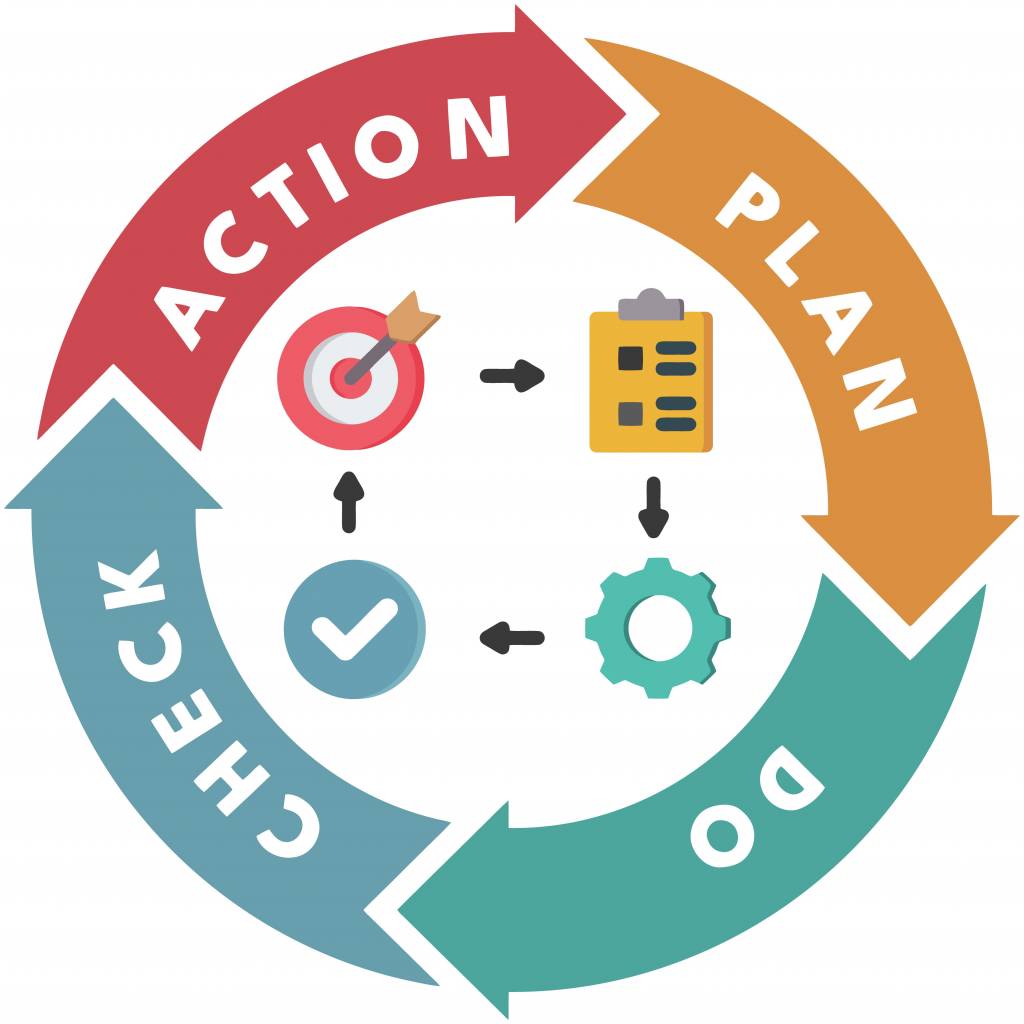
The PDCA Cycle for Process Improvement
PDCA is a process improvement cycle consisting of 4 main stages:
1. Plan: Analyze Problems and Plan for Improvement
The first step is identifying the problem, analyzing its causes, and determining guidelines to improve the work process. In this stage, organizations must answer critical questions such as:
- What is the problem?
- How often does it occur?
- What is the root cause?
- How should the process be modified to prevent recurrence?
Commonly used tools in this stage include:
- 5 Why Analysis
- Root Cause Analysis (RCA)
- Fishbone Diagram
- Gemba (On-site) Analysis
Specifically, 5 Why Analysis helps the team analyze problems systematically by asking “Why” repeatedly to uncover the true cause before defining solutions. Understanding the Root Cause accurately during the Plan phase is vital; if the analysis is flawed, the subsequent steps will fail to solve the problem sustainably.
2. Do: Implement the Plan (Trial)
Once the problem is analyzed and solutions are defined, the next step is to test the planned guidelines in the actual process. This trial often begins with:
- Testing on specific production lines.
- Testing within a limited timeframe.
- Testing in a Pilot Area.
The goal is to verify whether the designed guidelines effectively solve the problem before full-scale implementation.
3. Check: Monitor and Evaluate Results
After implementation, results must be systematically verified, checking for:
- A reduction in recurring problems.
- Improved work efficiency.
- Any adverse impacts on other processes.
Verification should rely on actual data, such as production logs, machine downtime, defect rates, and employee performance. If results do not meet the target, the team may need to return to the analysis phase—potentially using the 5 Why tool again—to find additional underlying causes.
4. Act: Standardize the Improvement
If the trial successfully solves the problem, the final step is to incorporate those guidelines into the organization’s Standardization. Examples include:
- Updating SOPs (Standard Operating Procedures).
- Adding machine inspection steps.
- Improving maintenance systems.
- Training employees on the new procedures.
Establishing new standards ensures that improvements become a permanent part of the workflow, preventing the original problem from recurring.
The Role of 5 Whys in the PDCA Cycle
While PDCA consists of four stages, the success of the improvement process depends heavily on the accuracy of the problem analysis in the Plan stage. If an organization fails to identify the correct Root Cause, the actions taken in the Do and Act stages may fail to provide a real solution.
Therefore, 5 Why Analysis plays a critical role in the Plan stage by helping the team:
- Gain a deep understanding of the problem’s origin.
- Differentiate between “Symptoms” and “Root Causes.”
- Prevent “firefighting” or surface-level problem-solving.
- Design highly targeted improvement guidelines.
When 5 Whys is used in conjunction with on-site data—such as Gemba observations or VDO Check inspections—problem analysis becomes significantly more precise, leading to more efficient and effective process improvements.

Examples of Problems Suitable for 5 Why Analysis
The 5 Why Analysis technique can be applied to a wide variety of workplace problems, particularly those involving efficiency, quality, and the continuity of the production process.
Examples of problems best suited for the 5 Why technique include:
Frequent Machine Downtime
Machine Downtime is a primary issue that directly impacts production efficiency. Without analyzing the root cause, teams may find themselves repeatedly repairing the same machinery without ever achieving a permanent fix.
5 Why helps the team trace the causes of stoppages, such as technical failures, inadequate maintenance schedules, or unbalanced process designs.
Inconsistent Product Quality
In manufacturing, inconsistent quality can stem from several factors, such as:
- Raw materials
- Machine settings
- Employee work procedures Using 5 Why allows the team to analyze the interconnections between these factors and discover the true cause of quality variances.
Production Delays
Delays in production may be caused by:
- Bottlenecks in the process
- Improper material management
- Redundant work steps 5 Why helps identify the exact point causing the delay, allowing for process improvements that boost overall efficiency.
High Defect Rates
High defect rates lead to increased production costs and reduced process effectiveness. 5 Why can help analyze whether defects originate from:
- The production process itself
- Quality control measures
- Employee training
- Product design Once the Root Cause is identified, the organization can improve processes to sustainably reduce waste and increase production efficiency.
Steps to Conducting an Effective 5 Why Analysis
Although 5 Why Analysis is a simple problem-solving tool, achieving accurate results requires a clear structure and actual data from the workflow to support the analysis. Simply asking “Why” without evidence can lead to inaccurate conclusions. Therefore, an effective analysis must be conducted step-by-step, verifying data at each stage.
Generally, the process of 5 Why Analysis can be divided into five main steps:
Step 1: Define the Problem Clearly
The first step is to create a clear Problem Statement so that all team members understand the issue from the same perspective. If the problem is vague, the subsequent “Why” questions may lead to a misguided analysis.
A good Problem Statement should:
- Clearly describe the event that occurred.
- Be measurable or specify the frequency of the problem.
- Avoid mixing in opinions or guesswork.
Example of a clear Problem Statement: “Machinery in Line A stops an average of 3 times per day.”
Step 2:Ask "Why" (1st–2nd times) to Find Initial Causes
Once the problem is defined, ask the first “Why” to find the immediate cause. These initial answers are often surface-level or direct events preceding the problem, such as:
- Employee error.
- Machine malfunction.
- Inconsistent raw material quality.
- Damaged components.
At this stage, teams should gather data from various sources like production reports, maintenance logs, and on-site observations to avoid concluding based on assumptions.
Step 3:Ask "Why" Successively Until the Root Cause is Found
Once the problem is defined, ask the first “Why” to find the immediate cause. These initial answers are often surface-level or direct events preceding the problem, such as:
- Employee error.
- Machine malfunction.
- Inconsistent raw material quality.
- Damaged components.
At this stage, teams should gather data from various sources like production reports, maintenance logs, and on-site observations to avoid concluding based on assumptions.
Example:
Why 4: Why was the pump damaged? → Because maintenance was not performed on schedule.
Why 5: Why was it not on schedule? → Because there is no notification system for maintenance.
In this case, the root cause is the management system, not just the machine.
Step 4:Verify the Cause-and-Effect Relationship
After identifying the root cause, you must verify the Cause-and-Effect Relationship. Every answer should logically explain how it leads to the next event.
Check if each step is supported by data, such as machine logs, quality reports, or Gemba video footage. If a connection is unclear or lacks evidence, you may need to re-evaluate and ask new questions.
Step 5: Define Countermeasures and Prevent Recurrence
The final step is to define Countermeasures that address the root cause directly. A good countermeasure should:
- Resolve the primary cause.
- Be practical for the actual workflow.
- Reduce the chance of the problem recurring.
Once implemented, results should be monitored continuously to evaluate if the solution effectively prevents the issue.
Techniques for Finding the "True" Root Cause
To ensure your 5 Why Analysis is accurate and targeted, keep these principles in mind:a
1. Avoid Responding with Opinions
A common mistake is answering based on personal opinions or experience without supporting data. A good analysis should be data-driven to confirm the actual cause.
2. Use Data and Evidence
Every answer should have supporting evidence, such as production logs, maintenance reports, or photos and videos from the site. This increases the reliability of the analysis.
3. Do Not Stop at "Human Error"
Teams often stop analyzing once they find that “the problem was caused by an employee’s mistake.” In reality, human error is often the result of a systemic flaw. You must ask further:
- Why did the employee make a mistake?
- Was the training system adequate?
- Are the work procedures clear?
- Is the equipment too difficult to use? These questions help uncover systemic issues, which are the true Root Causes.
Using Gemba VDO Check to Support 5 Why Analysis
While 5 Why Analysis is an effective tool for finding the root cause of a problem, many organizations find that their analysis often deviates from reality in practice. A major cause of this is using incomplete information or relying solely on guesswork, memory, or team opinions instead of actual workflow data.
For example, during a problem-solving meeting, team members might explain events based on what they think happened on-site. In reality, the actual workflow may involve overlooked details or events, such as abnormally long steps, machine micro-stoppages, or work behaviors that do not comply with standards.
To solve this, many organizations have adopted the Gemba VDO Check concept to collect actual on-site data, providing 5 Why Analysis with higher accuracy and reliability.
What is Gemba?
The word Gemba (or sometimes written as Genba) is a Japanese term meaning “the actual place where work happens.”
In the context of industry and production process management, Gemba refers to the areas where actual work activities take place, such as:
- The factory floor.
- Assembly lines.
- Material storage and movement areas.
- The actual workspace where employees perform their duties.
The Gemba concept is a fundamental principle in Lean Manufacturing and Kaizen. It is based on the belief that truly understanding a problem must start with observing the actual work process on-site, rather than analyzing problems solely from reports or meetings.
Executives or teams aiming to analyze problems effectively should perform what is called a Gemba Walk—visiting the site to observe the actual workflow, talking to employees, and gathering data from real-life situations.
This concept allows the team to:
- Understand actual working conditions.
- See problems that do not appear in reports.
- Understand the limitations of the work process.
- Identify the causes of problems more accurately.

Using VDO Check to Collect Workflow Data
While on-site observation improves problem understanding, a single visit may not be enough in cases where processes happen very rapidly or occur at different intervals. VDO Check, or video recording of work processes, is an essential tool that allows teams to capture detailed and comprehensive data from the site.
Recording actual work processes enables the team
1. Inspect Work Steps in Detail
Video allows teams to replay work steps multiple times, ensuring a precise analysis of process details, such as:
- Sequence of work steps
- Time spent on each step
- Employee movements
- Machine operations These details are critical for analyzing process-related issues.
2. Analyze Process Waste
Watching videos of work processes makes it easier for teams to identify Waste within the production line, such as:
- Waiting: Idle time for people or machines.
- Unnecessary Motion: Movements that do not add value.
- Overprocessing: Doing more work than required.
- Micro-stoppages: Brief machine interruptions. Once these wastes are identified, teams can use the data to improve workflow efficiency.
3. Pinpoint Problems Precisely
Sometimes, production issues occur only briefly and may go unnoticed during live operation, such as:
- Temporary machine halts
- Material jams
- Movements that cause minor delays Video allows the team to rewind to these specific events and analyze the root cause accurately.
How to Use Gemba Data to Answer "Why" Questions
When the team has data from a Gemba VDO Check, it can be used to effectively support the questions in the 5 Why Analysis process. Instead of answering “Why” based on guesswork, the team can use video evidence to explain actual events.
For Example:
- Abnormally Long Work Steps: Video might reveal that an employee spends significant time searching for tools or walking to fetch equipment from a distant area. This data answers the question: Why is the process taking longer than the standard?
- Unnecessary Motion: Video may show an employee bending, reaching, or turning multiple times to complete a single task. This “Why” analysis can lead to a redesign of the workspace.
- Periodic Machine Stoppages: Video footage might show a machine stopping because raw materials are not being fed continuously. This allows the team to ask the next “Why”: Why is the material preparation process delayed?
Real Data Increases 5 Why Credibility
Using data from Gemba VDO Check makes 5 Why Analysis more precise because every answer refers to actual on-site events. The benefits of using real on-site data include:
- Reducing analysis based on personal opinions.
- Increasing the reliability of the analytical results.
- Aligning the team’s vision of the problem.
- Providing data-backed support for process improvement decisions.
By integrating 5 Why Analysis with Gemba VDO Check, organizations can conduct deeper analyses and discover root causes with pinpoint accuracy. This forms a vital foundation for Kaizen-based process improvement and continuous organizational development.
If you want to learn more about production process analysis and using technology to boost efficiency, download Solwer’s E-Book today to explore guidelines and examples of using digital tools to enhance productivity and reduce waste in your organization.

into Productivity
industrial experts.