


Why is Video Necessary for a “Gemba Walk” in the Digital Age?
In the era of digital manufacturing, the traditional Gemba Walk has limitations, such as the inability to witness every moment of an event and share data instantly with off-site teams. The Digital/Virtual Gemba concept addresses this by using on-site video combined with real-time Cycle Time, IoT, and KPI data. This allows executives, engineers, and improvement teams to view the same shop floor, perform in-depth analysis, and make decisions based on factual data from anywhere. It enhances production efficiency, reduces waste, and drives sustainable KAIZEN, with further potential through Solwer’s solutions.
The Meaning of Gemba
You May Also Like
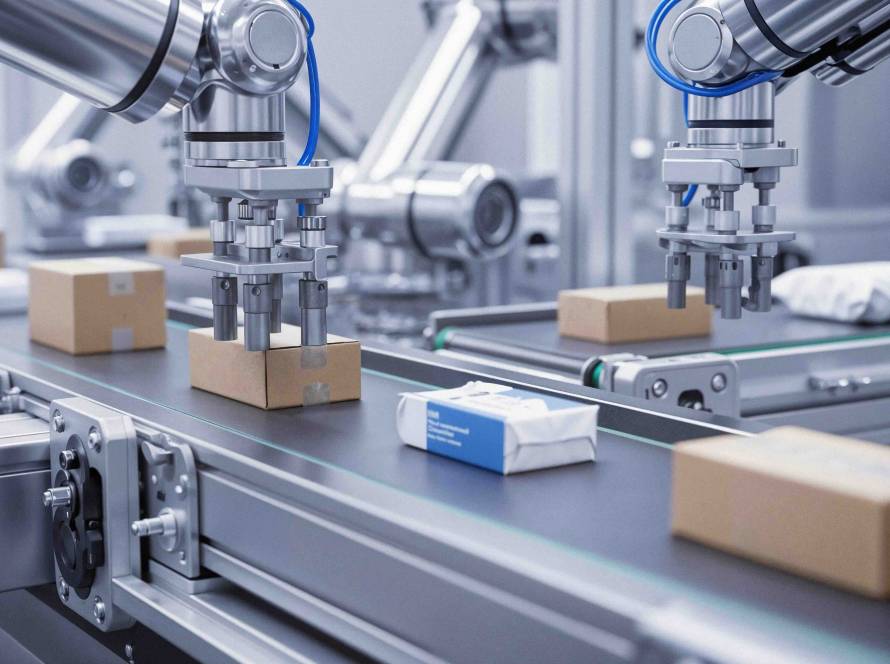
Gemba (เก็มบะ) is a Japanese word meaning “the actual place”. In the context of manufacturing, it refers to the area where real events occur, such as the shop floor, the assembly line, or the point where value is created for the customer. This concept emphasizes that executives and staff should go and observe, analyze, and understand problems at the source, rather than just working in meeting rooms or relying on historical figures from reports.
Why Gemba is Important in the Digital Age
1. Understand the True Root Cause (See the Reality)
Going to the Gemba allows one to see the actual working context, such as work processes, equipment, and employee interactions. Data from the actual place is less prone to error than merely reading reports, as reports can sometimes conceal the true root cause of a problem.
For example, a report might indicate “machine downtime,” but a physical Gemba visit might reveal that the main cause is waiting for parts or incorrect setup. This information is not available from reports alone.
2. Foster Team Engagement and Better Communication
When executives and staff go to the Gemba, face-to-face communication occurs with the frontline workers. Employees feel that their opinions are heard, leading to greater cooperation in improvement efforts. This environment helps build an engaged team and elevates the culture of continuous improvement.
3. More Accurate and Faster Decision-Making (Better & Faster Decision-Making)
Seeing the work as it actually happens enables executives to make decisions without relying on delayed documents or potentially inaccurate data, such as finding bottlenecks, processes that do not comply with standards, or recurring problems that reporting systems may overlook.
4. Truly Drive Continuous Improvement
Gemba is a crucial tool that helps teams repeat the cycle of Continuous Improvement, as going to the actual shop floor allows for immediate problem identification, cause analysis, and experimental resolution. This aligns with the KAIZEN principle, which focuses on small, continuous improvements.
5. Reflect Real Work Context that Digital Data Alone May Miss
Even though digital technologies like IoT systems or Dashboard collect Real-time data, digital figures alone are sometimes insufficient because quantitative data may not reflect context, such as communication errors, inappropriate equipment placement, or issues requiring understanding derived from talking to actual employees. A Gemba visit allows one to see both the “data” and the “context of the data” simultaneously.
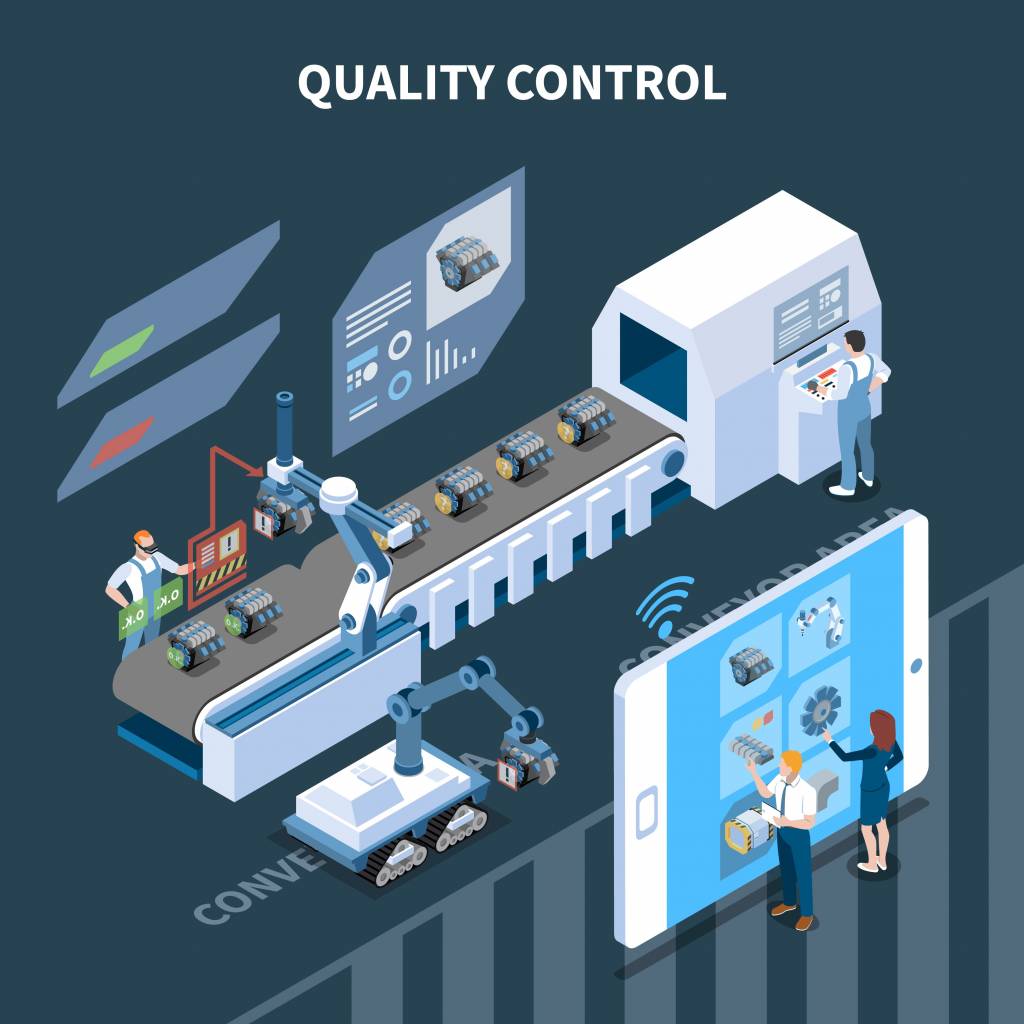
The Shift from Traditional Gemba to the Digital Gemba Walk
The traditional Gemba concept emphasizes “going to see the actual place” through walking the production line, talking to employees, and observing with one’s own eyes. This has long been the foundation of Lean, KAIZEN, and PDCA.
However, in an era where machines, software, and IoT systems are connected, machine behavior data and production line events are recorded in Real-time. This has led Gemba to evolve into a new format called:
Digital Gemba Walk
This is the use of digital data from the actual shop floor to support the observations of executives, Lean teams, and engineers, providing a view of real events in both quantitative figures and spatial context
Differences Between Traditional Gemba vs Digital Gemba Walk
| Topic | Traditional Gemba | Digital Gemba Walk |
|---|---|---|
| 1. Observation Method | Walking to see, observing with the eyes | Has Dashboard / Real-time data |
| 2. Problem-Finding Speed | Requires time to collect data | Identifies root causes instantly |
| 3. Data Error Rate | Depends on human note-taking | Depends on human note-taking |
| 4. Improvement Cycle | Weekly/Monthly | Hourly/Near Real-time |
| 5. Analysis Capability | Based on what is seen | In-depth analysis, e.g., Trend, Pattern, Correlation |
Why Adapt to the Digital Gemba Walk
1. Manufacturing Problems are More Complex
Modern production lines involve Automation, Robotics, and complex machinery. Observation by sight alone cannot reveal deep behaviors like vibration, cycle time variation, or micro stops
2. Need Data for Faster Decision-Making
Competition is higher. Waiting for end-of-shift or end-of-month summary reports is too slow, leading to delayed problem-solving and increased costs.
3. Reduce Errors from Manual Recording
In traditional Gemba, reliance is placed on on-site notes, paper, reports, or verbal accounts, which have high bias. Digital Gemba solves this with sensors and automated data collection systems.
4. Faster Linkage to PDCA and KAIZEN
Real-time data allows for:
- Plan with factual data
- Do immediate correction
- Check results instantly
- Act to set a new standard
Resulting in a Fast PDCA Loop.
5. Suitable for the Modern Workforce and Lack of On-Site Experience
Experience from senior operators fades over time. Digital Gemba helps store knowledge as data, reducing reliance on human memory.
Digital Gemba Does Not Replace Traditional Gemba, It “Empowers”
Walking the shop floor remains important, but instead of relying solely on sight and experience, executives can perform a Gemba Walk with a Dashboard and Real-time Alert in hand. This turns “what cannot be seen with the naked eye” into factual, verifiable, measurable, and actionable data.
This is why modern factories must adapt from the traditional Gemba to the Digital Gemba Walk to achieve Continuous Improvement quickly, accurately, and sustainably in the world of Industry 4.0.
Limitations of the Traditional Gemba Walk in a Fast-Changing World
Although Gemba is a key principle for shop floor improvement, relying on traditional methods like observation, manual note-taking, or human memory introduces clear limitations, especially in an era where production processes are more complex and change faster than before.
Key limitations include:
1. Inability to be on the shop floor constantly
Executives or Lean teams cannot monitor 24 hours a day. This results in many events going unnoticed, such as micro stops, temporary speed drops, or a machine issuing a warning and then reverting to work on its own, which may signal a larger problem in the future.
2. Seeing events only for short periods
The traditional Gemba walk reflects a picture of “that specific moment” only, without recording events before or after. This leads to a lack of trend perspective, such as:
- Frequency of stoppages
- Times when recurrence happens
- Groups of machines where problems frequently occur
This information is crucial for KAIZEN planning.
3. Certain details are lost when analyzing retrospectively
Data recorded manually or relying on human memory is often incomplete, such as:
- Actual start/stop times
- Actual speed during the incident
- Input/output volume
Retrospective analysis may lead to misinterpretation or inaccurate conclusions, resulting in ineffective problem-solving.
4. Difficulty communicating with off-site personnel
While the person on the floor understands the event, when communicating with other teams like Engineering or Maintenance, temporal details and evidence may be incomplete, leading to misalignment and slow problem resolution.
5. Modern manufacturing is too complex and fast to rely solely on “observation”
Automation systems, IoT, and high-speed machinery create events that are too rapid and subtle for humans to track, such as cycle time fluctuation at the second level or vibration signaling deterioration before an error code appears.
Impact of these limitations on problem-solving1
- Longer analysis time
- Slow PDCA loop
- Recurring problems
- Misdiagnosis of the cause due to incomplete data
- Lack of speed in quality control
While competitors can use Real-time data for immediate decisions, factories still using the traditional Gemba approach may suffer a significant time and cost disadvantage.
The Reason the Industrial World Must Shift to the “Digital Gemba Walk”
To reinforce the strengths of the traditional Gemba with Real-time shop floor data, helping to:
- See every event
- Know the true cause
- Improve quickly
- Make decisions based on verified data
This is the starting point for accurate and sustainable Continuous Improvement in the digital age.
Video is the Answer for Gemba in the Digital Age
Video helps capture the “reality of the shop floor” more completely than notes or static images—be it the sequence of work, wasted motion, waiting points, or behaviors causing defects. These details are often invisible from numerical data alone. Having video means Gemba is no longer restricted by time and location.
From Gemba Walk to “Virtual Gemba” Accessible Anywhere
In the past, performing a Gemba Walk meant executives, engineers, or improvement teams physically walked the shop floor to observe processes, understand problems, and speak directly with frontline workers. This is a fundamental principle of Lean Management and Continuous Improvement. However, in our connected world, this concept has evolved into what is called “Virtual Gemba” performing Gemba via digital technology, such as video and online platforms. This allows teams to access the shop floor view from anywhere, even if they are not physically in the factory at the same time.
What is Virtual Gemba
Virtual Gemba is the simulation or recording of an actual shop floor walk using digital media,such as video recording that can be played back later, allowing off-site teams to:
- See the actual shop floor conditions identically to the person on-site.
- Analyze past events when further explanation is needed.
- Collaboratively solve problems and make decisions without needing to be in the same location.
This concept expands Gemba’s role from a physical walk to a digital space where everyone can participate.
The Role of Video in Recording the Real Shop Floor Condition
Using “Video” is one of the essential tools of Virtual Gemba because it helps capture:
1. Sight and Sound of Real Events
Video can capture the complete picture of the work, time, machinery, and on-site conversations, which figures in a report cannot fully convey.
2. Ability to Review Multiple Times
Once an event is recorded, teams from various departments can go back and review it to:
- Check for missed observations.
- Analyze various overlapping factors.
Use it as a database for Workshops or PDCA.
These multiple reviews help problem-solving efforts rely on verifiable evidence, not just memory.
3. Collaborative Learning Environment
Video allows teams to:
- Share the shop floor situation with members in different locations.
- Discuss and explain problems with complete context.
- Ensure all parties understand “the same thing”.
This reduces misinterpretation and creates more efficient communication than merely reading text or summary reports.
Why Virtual Gemba is Important Today
The business world is changing fast today. Organizations must accelerate process improvement, and customer expectations are rising:
- Teams in different locations can access the same information instantly.
- Reduces time spent on each site visit and allows continuous data collection.
- Supports collaboration even with geographically dispersed teams.
- Recorded video and digital data can be used for training or as a continuous knowledge base.
Therefore, Virtual Gemba is not just a “new alternative” but an adaptation to a work environment not limited by space, meeting the demands of modern organizations for speed, accuracy, and engagement from all parties in continuous improvement.
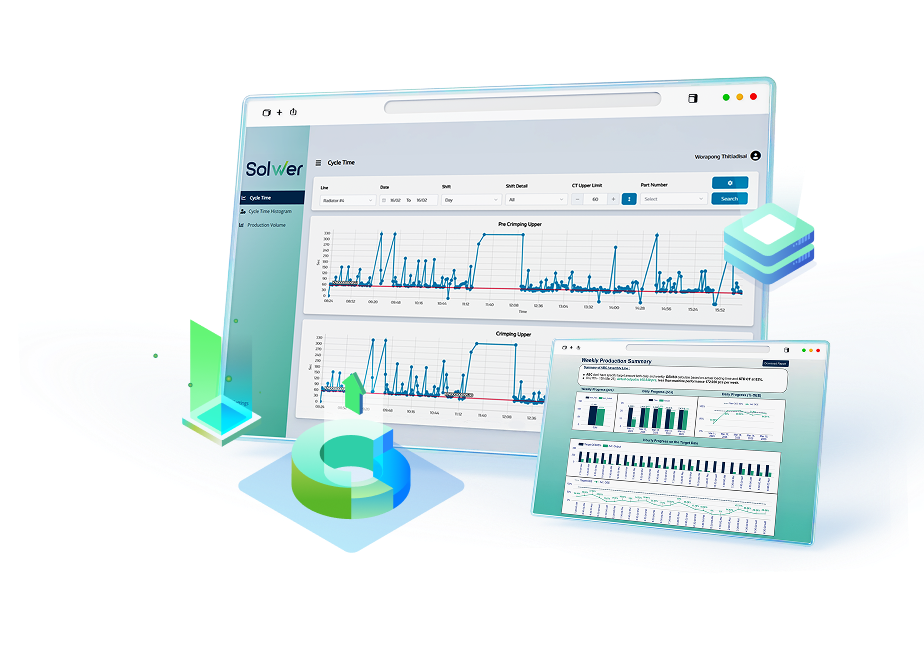
Solwer’s Loss Tracker is one solution that extends the Gemba and Virtual Gemba concepts toward in-depth analysis using factual data. It is not merely standard shop floor video recording but combines camera footage with critical numerical data such as Cycle Time, loss duration, and other abnormal signals. This turns video into actionable analytical data, not just static evidence or anecdotal accounts. Download Solwer’s e-book to learn more in-depth Solwer data.
Loss Tracker: The Tool That Transforms Video into Analytical Data
Not Just “Recording Video,” But “Recording with Essential Data”
Loss Tracker is designed to connect video with real data signals from the factory, such as Cycle Time measured by sensors or machine signals. When the system detects an abnormality or a deviation from the standard time, the video is captured and instantly linked with the numerical data. This means each video clip has a clear context, consisting of the time of the incident, Cycle Time data, and the reason for the detected abnormality, ready for systematic analysis.
Image and Figures Combined in the Same Context Reduces Misinterpretation
One limitation of ordinary video recording is the lack of surrounding data, such as the actual time spent in each production cycle or how the clip relates to KPIs that measure machine performance. However, Loss Tracker stores both the actual video footage and numerical data like Cycle Time, Output, and defined abnormality times within the same context. This allows the team to view the images and data side-by-side to understand the actual situation and significantly reduce misinterpretation from a “single viewpoint” alone.
More Accurate Problem Analysis with Video and Cycle Time Data
When the team has video linked to Cycle Time data at hand, asking and answering analytical questions becomes much clearer, such as:
1. Which Step Caused the Time Loss?
With Cycle Time data attached to the video, the system helps identify time periods with slow or stopped production cycles. It clearly shows which part of the process caused the maximum time loss and categorizes it as the true root cause.
2. Is the Problem Recurring in the Same Pattern?
Comparing videos across multiple time periods reveals the Pattern of events, such as repeated stoppages or the same abnormality recurring at the same time, which is crucial data for Root Cause analysis.
3. Is the Loss Caused by Work Method, Machine, or Management?
By having both real video footage and supporting numerical data, the team can separate whether the “true root cause” is human error, inappropriate machine setup, or process limitations. This helps ensure that the Root Cause analysis is accurate and factual, rather than relying solely on personal feeling or experience.
Why Loss Tracker is the Foundation for In-Depth Analysis
Loss Tracker is not merely a recording system but an integrated data platform that connects:
1. Video Evidence from the shop floor
Video from the shop floor is “visual evidence” that shows the actual condition at the time of the event, such as a machine stoppage, a person waiting for raw materials, or a workpiece dropping.
The importance of video in Loss Tracking:
- See the actual process, not just figures.
- Helps the team understand the context, such as motion, tool usage, or delays.
- Serves as neutral data that all parties can review.
- Confirms the actual event, reducing disputes like “Did it really happen? When? Where?”.
The result is that video makes problems “tangible,” not just assumptions.
2. Actual Working Time Data (Cycle Time – CT)
Cycle Time (CT) is the “actual time spent per unit for one production cycle . When collected in real-time, it clearly indicates:
- Which cycles are fast or slow
- Which activities cause time loss
- When waiting time occurs between cycles
This reveals the variation in working time during each cycle, which is important evidence for Root Cause Analysis.
Example Benefits:
- If Cycle Time increases → Must find the cause
- If some cycles are faster than standard → Study best practice
- If delays recur during certain periods → See the pattern
3. Anomaly Signals from IoT/Sensors (IoT anomaly signals)
IoT systems can send real-time status measurement and event detection signals from machinery, such as:
- Reduced rotational speed
- Abnormally high vibration
- Sensor failure to detect raw materials
- Machine stoppage (downtime)
When an anomaly signal is detected, the system will:
- Record the timestamp
- Link the event to the video
The advantage is that the team can “know instantly when an event occurs” without waiting for operators to report verbally.
4. Numerical context for KPI & analysis
This is “data that quantitatively describes the event,” such as:
- Downtime duration for each stop
- Number of event occurrences
- CT deviation compared to the standard
- Productivity loss (%)
Numerical context helps to:
- Convert problems into measurable results
- Identify affected KPIs
This makes the problem “clearly visible” and allows for calculating the ROI of the solution. With both data types combined, Loss Tracker enables teams to perform Root Cause analysis, identify problem patterns, and plan systematic and accurate solutions, aligning with the concepts of continuous improvement (KAIZEN) and decision-making based on factual data in the digital enterprise.
In-Depth Problem Analysis with Video and CT Data to Find the Root Cause
When loss occurs in the production process, such as machine stoppage or slow production cycles, teams often need to find the Root Cause. However, relying solely on visual recording or retrospective questioning often leads to memory lapses or incorrect assumptions.
Having Real-time Video + Cycle Time (CT) data helps ensure more accurate analysis for the following reasons:
1. See the “Actual Event” During Periods of Abnormal CT
When CT is higher than the standard, the video recorded with time data indicates what happened, such as:
- Worker waiting for the machine
- Slow tool change
- Machine malfunctioning intermittently
The point where the CT is abnormally high is the point that requires in-depth analysis (Kaizen Target Point).
2. Conduct Evidence-Based Root Cause Analysis, Not Feeling-Based
Normally, team members might describe the event differently. However, having video synchronized with CT allows for:
- Seeing the actual sequence of events
- Checking the time used in each step
- Separating each type of loss, such as Waiting, Motion, and Minor Stop
This allows answering Root Cause questions such as:
- Why did CT increase?
- Did it recur?
- Which time period or operator influenced the CT?
3. Discover Patterns and Trends Faster
With continuous CT data, teams see recurring abnormalities, such as:
- Occurring every morning before break
- Occurring only in the afternoon shift
- Occurring when the batch changes
These are Key insights that help ensure Kaizen solutions are more targeted.
Summary:
Real-time CT + Video = Verifiable data → Reduced errors → Accurate Root Cause → Faster Kaizen implementation
Sharing and Communicating Gemba Data Instantly to Off-Site Teams
This is the core of the shift towards Digital Gemba / Virtual Gemba in the modern factory.
The previous problems were:
- Executives did not see the actual shop floor.
- QA/Lean and Maintenance teams analyzed events retrospectively.
- Data passed through multiple people’s minds, and context was distorted.
With automatically recorded video and CT, data can be shared directly from the shop floor instantly via the Loss Tracker system or Real-time Dashboard.
What can be shared in Real-time includes:
- Video footage of the problem period
- CT deviation indicating loss
- Timestamp and bullet event
- Anomaly signals from IoT/sensors
Overview of affected KPIs
Benefits of Sharing Gemba Data in Real-time
1. Everyone Sees the Same Data, Eliminating Arguments about “What Happened”
Reduces bias from memory or personal opinion.
2. Reduces Waiting Time for On-Site Meetings
Teams can start problem analysis immediately, even if they are in different factories/shifts.
3. Accelerates the PDCA Loop
When data flows in real-time, problem-solving decisions can be made instantly.
4. Stores Data as a Knowledge Base (Process learning)
Used as case study examples or for training new operators.
Example Workflow for Gemba Communication via a Digital System
- IoT system detects abnormally high CT
- Video of that time period is recorded automatically
- An alert is sent to the team via the Dashboard / Mobile App
- All teams instantly view the event with accompanying figures
- Root Cause Analysis begins even when not physically on the shop floor.
Value Organizations Receive from Elevating Gemba to Digital/Virtual Gemba Using Real-time Data
| What Video Provides | What CT Provides | When Combined, You Get... |
|---|---|---|
| Actual visual event evidence | Temporal, factual figures | Verifiable Root Cause |
| Reduces disputes | Reduces assumptions | Faster PDCA |
| Easy to communicate | Stores history for standard comparison | Sustainable Kaizen |
Summary of Key Reasons Why Video is Important in the Digital Gemba Era
1. Records Real Events in All Dimensions
- Video captures actual work footage, machinery, and the environment.
- Does not miss temporary events (micro stop, minor stop).
- Allows seeing the sequence of problems along with the context.
3. Enables Sharing and Communication with Off-Site Teams
- Virtual Gemba allows all parties to access the same information.
- Lean, Maintenance, and executive teams can analyze collaboratively and instantly.
- Reduces time for repeat site visits and errors from communication.
4. Supports Root Cause Analysis and Continuous Improvement
- Having video helps clearly verify the cause of problems.
- Allows comparison of event patterns retrospectively.
- Accelerates and makes the PDCA Loop more accurate.
5. Creates a Knowledge Base and Verifiable Evidence
- Video is data that records real events and is traceable.
- Used as case studies, for training, or for future KPI development.
In the digital age, performing Gemba must include video because it transforms observation from being sight-based to being based on factual data that can be verified, shared, and deeply analyzed, making Continuous Improvement and Kaizen happen more efficiently and quickly than before.1
If you wish to learn more and design a digital Gemba system complete with Loss Tracking, Real-time Dashboard, and a PDCA Loop driven by factual data, you can use Solwer’s services to create these systems immediately. Download Solwer’s e-book now!

into Productivity
industrial experts.