
Skip to content Skip to footer

How-to Practical Implementation: Organizational Transformation via Top-Down and KAIZEN

How-to Practical Implementation: Organizational Transformation via Top-Down and KAIZEN

As factories worldwide face mounting pressures regarding costs, energy, and sustainability, many organizations are asking: “How can we start Lean & Clean effectively?” and “Why do so many projects fail despite heavy investment in technology?” Today, Solwer will clarify that transitioning to a modern factory does not begin with machines or automation alone, but with “organizational mindset”—starting from executive policy down to fostering a KAIZEN culture where everyone participates in reducing MUDA (waste) and driving continuous improvement.

Why Top-Down? When "Vision" Must Lead "Systems"

Implementing Lean & Clean at an organizational level is not just about adopting tools like 5S, Kaizen, or OEE at the shop floor; it is about “redefining the entire decision-making process,” from management down to operations. In reality, the root of factory problems often lies in the “system design” inherited over time rather than a single point of failure.

If transformation starts solely from operations (Bottom-Up), small improvements may occur, but it cannot address the “root cause” due to limitations in decision-making authority, budgets, and policy frameworks. Conversely, a Top-Down drive acts as a “key” that unlocks structural change (System-level Change).

Lean Transformation is "System Redesign," Not Just "Point Improvement"

Research on Lean Transformation clearly states that successful organizations must have strong Executive Commitment to determine the organization’s trajectory.

Key Differences:

  • Without Top-Down → Leads only to “Local Improvement.”
  • With Top-Down → Leads to “System Redesign.”

Limitations of Bottom-Up (Without Top-Down Support)

While Bottom-Up is crucial for Kaizen, it has distinct limitations without top-level guidance:

  • Stuck in Firefighting: Teams solve immediate issues like defects or downtime but cannot fix systemic root causes.
  • No Authority for Structural Change: Such as changing factory layouts, integrating processes, or investing in automation, which requires executive approval.
  • Impact Limited to Small Areas: Improvements become “islands” (Isolated Improvements) that cannot be linked into a total system flow.
  • Silos Between Departments: Each team optimizes its own area rather than the entire organization.

The Power of Top-Down: When "Policy" Becomes an Accelerator

When senior management signals clearly that “MUDA (waste) is the organization’s enemy,” change occurs simultaneously across three key levels:

1. Unlock Resources

  • Budgets for Lean & Automation are approved faster.
  • Ability to invest in high-impact projects.
  • Removal of multi-layer approval constraints.

2. Faster Decision Flow

  • Reduced time for cross-departmental approval.
  • Faster strategic decision-making.
  • Reduced management-level bottlenecks.

3. Organization-wide Alignment

  • All departments share aligned KPIs.
  • Reduced conflicts between Production, Engineering, and Finance.
  • Lean becomes “Corporate Culture” rather than just a “Project.”

Top-Down Does Not Replace Bottom-Up, But Must "Work Together"

Crucially, Top-Down does not replace front-line problem-solving; its role is to:

  • Set Direction
  • Constraint Removal
  • Create an environment conducive to Kaizen

Meanwhile, Bottom-Up is responsible for:

  • Execution
  • Experimentation
  • Continuous Improvement

Communication Techniques: Turning "Burden" into "Ease"

A primary reason for Lean Transformation failure is not the tools, but “poor communication from the start.” Employees often perceive Lean as increasing workload, adding KPIs, or acting as a surveillance tool. In reality, Lean is designed to “make work easier, faster, and less strenuous.”

Therefore, the executive challenge is not just system design but changing the “perception” of the entire organization, so they understand Lean as a tool that concretely improves their work life.

Effective Communication Methods for Lean

1. Language Shift: From "Cost" to "Well-being"

Traditional communication focuses on:

  • Cost Reduction
  • Efficiency
  • Productivity

While correct in business terms, employees often interpret these as “working more for the same pay.” An effective approach “translates KPIs into human language,” such as:

  • From “Reduce production time by 20%” → “Stop waiting for the machine for 30 minutes per cycle.”
  • From “Increase Productivity” → “Finish work faster, go home sooner.”
  • From “Reduce Labor Cost” → “Remove unnecessary, repetitive tasks.”

Key Insight: Humans are not driven by numbers, but by “feeling better in their work life.”

2. Use Concrete Metrics (Visual & Operational Metrics)

Lean is most powerful when “visible.” Because what is invisible will not be believed.

Instead of complex technical figures, use data that everyone “feels,” directly linked to the shop floor:

  • kWh reduced → Shown as “Daily electricity cost saved.”
  • Time Saving → Shown as “Minutes without standing idle.”
  • Cost reduction → Shown as “Money lost to errors.”

Visual Management Techniques:

  • Use Shopfloor Boards.
  • Compare Before vs After clearly.
  • Use colors/graphs/icons instead of complex numbers.

3. Build Meaning (Purpose-Driven Lean): From "Tasks" to "Purpose"

The most powerful communication isn’t money, but the “purpose of the work.” Lean is better accepted when employees feel their work has more value than just producing goods.

How to Build Meaning in the Organization

Connect Lean to ESG and Sustainability:

  • Reduce Energy → Reduces Carbon Emissions.
  • Reduce Waste → Reduces industrial waste.
  • Reduce Overproduction → Reduces unnecessary resource consumption.

Example communication that changes Mindsets:

  • “We are not just cutting electricity; we are reducing carbon in every piece.”
  • “We are not just reducing steps; we are making your work easier every day.”
  • “Every minute saved is time you don’t have to spend unnecessarily.”
Lean

How to Start for "Real Results"? Quick Win Strategy for Lean & Clean Factories

For factories just starting, attempting to overhaul the entire system simultaneously often fails due to time consumption, high risk, and lack of tangible success. The effective strategy is starting with “Quick Wins”—small points that yield rapid results—to build momentum and internal organizational drive.

The heart of a Quick Win isn’t choosing the easiest task, but picking the “right spot” with high impact, visible results, and scalability.

1. Choose a "High Impact Area"

The best starting point processes that:

  • Are Bottlenecks in the production line?
  • Have High Waste, such as long waiting times, excessive movement, or frequent defects.
  • Have abnormally high energy usage
  • Impact the Output or Lead Time of the entire system.

The reason is that when these points are improved, the results “reflect across the system,” making everyone immediately see the value of Lean.

Good Quick Win Examples:

  • Downtime Reduction.
  • Reduce WIP between 2 processes.
  • Combine 2 steps into one (Mini Single Shot).

2. Feasible to Execute

A good Quick Win is not a 6–12 month project but should:

  • Take about 2-6 weeks
  • Does not require a high investment.
  • Allow for rapid experimentation and adjustment.

Because the main goal of a Quick Win is “generating fast results,” not “perfection on the first try.”

3. Scalable

A good Quick Win should not be an isolated success but must:

  • Apply the concept to other lines.
  • Be replicable in multiple areas.
  • Become a new organizational standard.

Example: If you reduce waiting time in line A by 30%, the next question is “Can we do the same for line B?”

4. Cross-functional Team

Quick Wins happen much faster with teams that “see the whole system,” not just one angle.

A good team should consist of:

  • Production (Real shop floor knowledge)
  • Engineering (Technical problem solving)
  • Quality (Control standards)
  • Finance (Measure cost impact)

Advantages of Cross-functional Teams:

  • Reduced Silos.
  • Faster decisions.
  • End-to-End problem solving.

5. Visualize Everything

Quick Win is meaningless if people in the organization “cannot see the change.”

Essentials include:

  • Clear Before vs After.
  • Shop floor dashboards.
  • Simple KPIs like time/money/energy.

Visualization Examples:

  • From 10 minutes → to 6 minutes.
  • From 100 kWh → to 70 kWh.
  • From 5 defects/day → to 1 defect/day.

When people “see” the results, they will “believe” and want to continue.

Formula for a Good Quick Win

A quality Quick Win must have 3 complete components:

  • Fast Impact → Within 1–2 months.
  • Measurable → Clear figures.
  • Scalable → Replicable across the factory.

Starting Lean & Clean does not require a big start, but a “correct” start. Because small successes build:

  • Confidence.
  • Motivation.
  • Adoption.

Which are more important than any investment or technology.

Key Insight: Don’t start with the biggest project; start with the project that “can be proven fastest.” Because Lean that people believe in will expand itself without forcing.

5S and KAIZEN: From "Tidiness" to "Sustainability and Data-Driven"

Historically, 5S and KAIZEN were used as basic tools for shop-floor improvement, focusing primarily on “order, cleanliness, and ease of work.” This was a good starting point for Lean, but in today’s industrial context—where energy costs are higher, environmental pressure is mounting, and competition requires speed and data—the old approach is no longer sufficient.

First, let’s get to know 5S and KAIZEN.

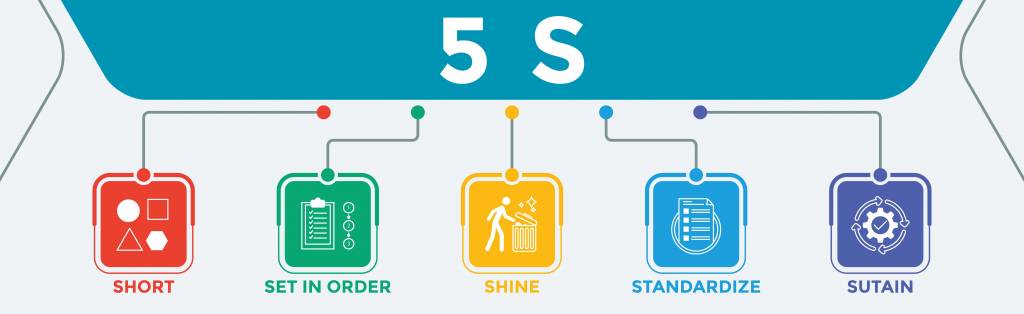
5s

What is 5S?

5S is a fundamental concept for organizing and improving the workplace to be efficient, rooted in Japan’s Lean production system. The goal isn’t just “cleanliness,” but making work easier, faster, safer, and reducing waste systematically.

The word “5S” comes from the first letters of 5 Japanese words, describing steps for managing the workspace sequentially.

1. Sort (Seiri): Separate necessary from unnecessary

Sorting items in the workspace:

  • Anything “unnecessary” → Remove it.
  • Anything “necessary” → Keep it.

Goal: Reduce clutter, excess items, and waste.

2. Set in Order (Seiton): Arrange for easy access

Organize necessary items:

  • Easy to grab.
  • Easy to use.
  • Return to the same place immediately.

Goal: Reduce search time and make workflows fluid.

3. Shine (Seiso): Clean and inspect

Not just cleaning, but “inspecting while cleaning”:

  • Wipe machines = Check for abnormalities.
  • Clean = Reduce damage risk.

Goal: Prevent problems before they occur (Preventive Maintenance).

4. Standardize (Seiketsu): Create a unified system

Define working standards, such as:

  • Labels.
  • Colors.
  • Storage methods.

Goal: Ensure everyone works the same way, reducing errors.

5. Sustain (Shitsuke): Make it a habit

Make 5S not just a temporary activity, but an organizational culture:

  • Do it consistently.
  • Audit and continuously improve.

Goal: Build sustainable behaviors.

Why is 5S Important?

While it seems basic, 5S is the “foundation of Lean systems and smart factories,” helping to:

  • Reduce Waste (Waiting, walking, searching).
  • Increase Productivity without additional investment.
  • Make problems “Visible” (Visual Management).
  • Serve as a foundation for Automation and Digital Factory.

What is KAIZEN?

KAIZEN is a concept of continuous improvement from Japan, focusing on “making it better by a little, but doing it every day” rather than one big change. The goal is to reduce waste, increase efficiency, and elevate quality consistently at all organizational levels.

The Core of KAIZEN

KAIZEN is not just a tool, but a “mindset” that believes “every process can always be improved.”

And the improvement is not just the duty of executives or engineers, but the duty of “everyone” in the organization, from the shop floor to the management level.

Key KAIZEN Principles

1. Improve little, but continuousl

  • No need to wait for big projects.
  • Focus on small, immediate changes.
  • Accumulate long-term results.

2. Reduce Waste (MUDA

KAIZEN aims to eliminate non-value-adding activities such as:

  • Waiting.
  • Motion.
  • Overproduction.
  • Defects.

3. Use Data and Facts (Fact-based)

  • Improve based on “real data,” not feelings.
  • Measure Before / After.

4. Everyone participates

  • Open opportunities for employees to propose ideas.
  • Let the shop floor improve their own work.
  • Build a shared learning culture.

KAIZEN Examples in Factories:

  • Reduce equipment retrieval time from 5 minutes → 30 seconds.
  • Adjust tool positioning to walk less.
  • Combine work steps to finish at one point.
  • Reduce machine energy usage.

KAIZEN vs Traditional Improvement

KAIZEN สำคัญอย่างไร?

  • ทำให้ระบบ “ดีขึ้นทุกวัน” โดยไม่ต้องลงทุนสูง
  • สร้างวัฒนธรรมที่คนกล้าคิด กล้าปรับปรุง
  • เป็นรากฐานของ Lean, Automation และ Smart Factory
  • ช่วยให้องค์กรปรับตัวได้เร็วในโลกที่เปลี่ยนแปลงตลอดเวลา

5ส. และ KAIZEN ในวันนี้จึงไม่ได้หยุดอยู่แค่ “จัดให้เรียบร้อย” แต่ถูกยกระดับให้เป็น “เครื่องมือเชิงกลยุทธ์” ที่เชื่อมโยงกับพลังงาน คาร์บอน และผลลัพธ์ทางธุรกิจอย่างชัดเจน

Concept Traditional KAIZEN
Change Big changes Small, continuous
Actors Management / Experts Everyone
Frequency Occasional Constant
Risk High Low

Why is KAIZEN Important?

  • Makes the system “better every day” without high investment.
  • Builds a culture where people dare to think and improve.
  • Is the foundation of Lean, Automation, and Smart Factory.
  • Helps the organization adapt quickly in a constantly changing world.

5S and KAIZEN today have evolved beyond “just tidying up” to become “strategic tools” clearly linked to energy, carbon, and business results.

1. From "Orderliness" to "Energy & Carbon Awareness"

Traditional Approach

  • Focus on cleanliness, order, and easy access.
  • Reduce search time.
  • Prevent accidents in the workplace.

Modern Concept

  • View 5S as a “Tool to visualize energy and waste.”
  • Everything unnecessary = energy used without creating value.

Example Perspective Shift:

  • Machine left on = “Wasted Energy.”
  • Excess storage space = “Space requiring extra lighting/AC electricity.”
  • Walking far for items = “Wasted human energy.”

2. From "Using Experience" to "Data-driven KAIZEN"

Traditional Approach

  • Decide based on the supervisor’s experience.
  • Use intuition like “probably better.”
  • Measure unsystematically.

Modern Concept

  • KAIZEN in the Industry 4.0 era uses “real data” to drive decisions such as:

    • Sensors measuring machine energy usage.
    • IoT collecting cycle time data in real-time.
    • Dashboards showing production line performance.

Distinct Outcomes

  • From “think it’s better” → to “prove it’s better.”
  • From “fix by feeling” → to “optimize by data.”

3. From "Aesthetics" to "Business & ESG Impact"

Traditional Approach

  • Measure based on area orderliness.
  • Use Audit Checklist (Pass / Fail).
  • Focus on the shop-floor image.

Modern Concept

5S and KAIZEN must link to “business results” and “sustainability.”

Metrics Used Today

  • Energy per Unit (kWh/piece).
  • Carbon Emission per production.
  • Lead Time reduced.
  • Productivity increased.
  • Measurable Cost Saving.

4. The New Role of 5S: "Foundation of Automation and Smart Factory"

Today, 5S is not just for humans; it is the “foundation of automated systems.”

Why?

  • Robots need predictable environments.
  • Sensors need noise-free environments.
  • Data needs standardized processes.

Thus, Modern 5S means:

  • Organizing for machine precision reading.
  • Making abnormalities “immediately visible.”
  • Creating standards that support Automation.

Ultimately, Lean & Clean is not just a cost-cutting tool but a transformation of the entire organization to operate more efficiently, flexibly, and sustainably. Starting with clear Top-Down direction, combined with daily KAIZEN at the operational level, will enable organizations to truly reduce MUDA and connect operations to Energy, ESG, and Data-driven Manufacturing. Because in the modern industrial world, the most competitive factory may not be the largest, but the one that “improves fastest” and learns continuously. To help your organization start this systemic transformation and grow sustainably in the long term, check out the Solwer e-Book now!

Leave a comment